What you need to provide in order to use Peacemaker
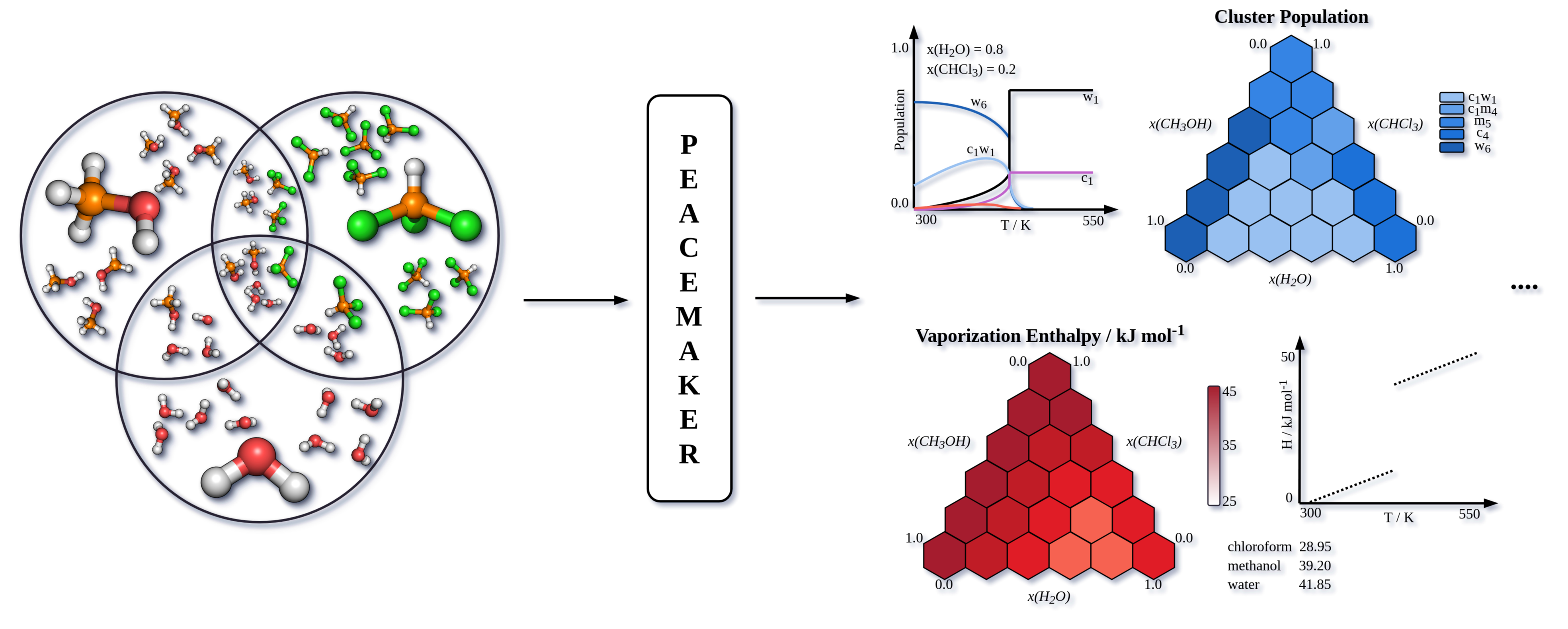
A set of clusters, which are representative for the system you want to investigate
The vibrational frequencies of the clusters
The volumes for the monomers
The molar amounts of the components in your system
The adiabatic interaction energy of the clusters
For units and formatting, see the section, Clusterset file.
What you get from Peacemaker
The Gibbs free energy of the system
The Helmholtz free energy of the system
The internal energy of the system
The enthalpy of the system
The entropy of the system
The heat capacity at constant volume
The heat capacity at constant pressure
The volume of the system
The population each cluster motif
The concentration of each cluster motif
A set of contributions for each degree of freedom to the thermodynamic quantities
A set of contributions for each cluster to the thermodynamic quantities
Peacemaker
Where to find example clustersets for QCE calculations using Peacemaker
You can find example clustersets for QCE calculations using Peacemaker in the Repository of the Kirchner group.
Where to find our Publications
On our webpage you can find all publications of the Kirchner group. The publications related to Peacemaker are listed below:
Please always cite the following publication when using Peacemaker:
Michael von Domaros, Eva Perlt, Johannes Ingenmey, Gwydyon Marchelli, Barbara Kirchner: “Peacemaker 2: Making clusters talk about binary mixtures and neat liquids”. SoftwareX (2018).
Barbara Kirchner, Christian Spickermann, Sebastian B. C. Lehmann, Eva Perlt, Johanna Langner, Michael von Domaros, Patricia Reuther, Frank Uhlig, Miriam Kohagen, Marc Brüssel: “What can clusters tell us about the bulk? PEACEMAKER: Extended quantum cluster equilibrium calculations”. Comput. Phys. Commun. 182 (2011), 1428.
Barbara Kirchner: “Cooperative versus dispersion effects: What is more important in an associated liquid such as water?” J. Chem. Phys. 123 (2005), 204116.
For multicomponent mixtures, please cite:
Tom Frömbgen, Katrin Drysch, Paul Zaby, Jürgen Dölz, Johannes Ingenmey, Barbara Kirchner: “Quantum Cluster Equilibrium Theory for Multicomponent Liquids”. J. Chem. Theory Comput. 20 (2024), 1838-1846.
For binary mixtures, please cite:
Marc Brüssel, Eva Perlt, Sebastian B. C. Lehmann, Michael von Domaros, Barbara Kirchner: “Binary systems from quantum cluster equilibrium theory”. J. Chem. Phys. 135 (2011), 194113.
For anharmonicities, please cite:
Michael von Domaros, Eva Perlt: “Anharmonic effects in the quantum cluster equilibrium method”. J. Chem. Phys. 146 (2017), 154502.
For acid constants, please cite:
Eva Perlt, Michael von Domaros, Barbara Kirchner, Ralf Ludwig, Frank Weinhold: “Predicting the ionic product of water”. Sci. Rep. 7 (2017), 10244.